
What Are Wendy’s Burgers Made Of? Beef Sourcing Explained (2026)
Short answer: Wendy’s burgers are made from 100% real beef with no fillers, extenders or additives, sourced from Beef Quality Assurance certified farmers and ranchers in North America, delivered chilled rather than frozen, and formed into the chain’s signature square hamburger patty. The company’s core claim — “fresh, never frozen” — is a genuine supply-chain commitment, not just a slogan, though it comes with regional caveats worth understanding.
Below: exactly what goes into the patty, what “fresh, never frozen” does and does not mean, why the patty is square, where the beef actually comes from, and how it compares to the chains people usually ask about in the same breath.
What’s Actually in a Wendy’s Beef Patty?
The patty itself is short on ingredients by design. Wendy’s official fresh beef page states its beef is “100% real beef” with “no fillers or additives.” There is no soy extender, no textured vegetable protein, and no binding agent in the raw patty.
Seasoning is applied on the grill rather than mixed into the meat — salt and pepper, added during cooking. This is a meaningful distinction: chains that pre-season or pre-blend seasoning into the grind are working with a different product than one that seasons at the point of cooking.
The beef is a ground blend rather than a single cut. Discussion among crew on the r/wendys subreddit consistently backs the daily chilled-delivery routine. Like effectively all commercial burger production, it uses trimmings from several primal cuts to hit a consistent fat ratio, which is what delivers repeatable flavour and texture across thousands of restaurants.
What “Fresh, Never Frozen” Actually Means
This is the claim most worth unpacking, because it is widely repeated and rarely explained.
“Fresh, never frozen” means the beef is held and transported refrigerated, not frozen, from supplier to restaurant. Wendy’s describes shipping in refrigerated trucks “thousands of times every week,” with temperature monitored in transit, and patties cooked from chilled on the grill.
The company draws the contrast bluntly in its own materials: “You won’t find frozen pucks passed as a meal at Wendy’s… unlike what the other guys are serving up.”
The operational consequence
Chilled beef has a far shorter usable life than frozen beef, which forces three things most customers never see:
- High delivery frequency. Restaurants receive beef multiple times per week rather than storing months of stock.
- Geographic constraint on suppliers. Wendy’s states it sticks with “the freshest suppliers close to home, so we don’t have to turn to the freezer.” Chilled beef cannot travel indefinitely.
- Tighter forecasting. Over-ordering means waste rather than freezer stock.
The caveat worth knowing
The fresh beef commitment applies to the contiguous United States, Alaska, Canada, Mexico, Puerto Rico, the UK and select international markets. It is a market-by-market standard, not a universal one — so in some international locations the supply chain differs. If this matters to you, it is worth asking locally rather than assuming.
Uncertainty flag: “fresh, never frozen” describes the supply chain up to the grill. It is not a claim about grind date, and Wendy’s does not publish how long chilled beef may be held in-restaurant before use.
Where Does Wendy’s Beef Come From?
Wendy’s states that 100% of its fresh beef comes from Beef Quality Assurance (BQA) certified farmers and ranchers. BQA is a cattle-industry certification programme covering animal handling, health management and record-keeping.
Sourcing is regional rather than global. Because chilled beef cannot be shipped long distances, the supply base is necessarily domestic and near-market — which is the practical reason behind the “close to home” language, not merely a marketing preference.
What Wendy’s does not publish is a named supplier list or farm-level traceability. That is standard across the fast-food sector, but it means the BQA certification is the specific, checkable claim rather than “we know every farm.”
Why Is the Patty Square?
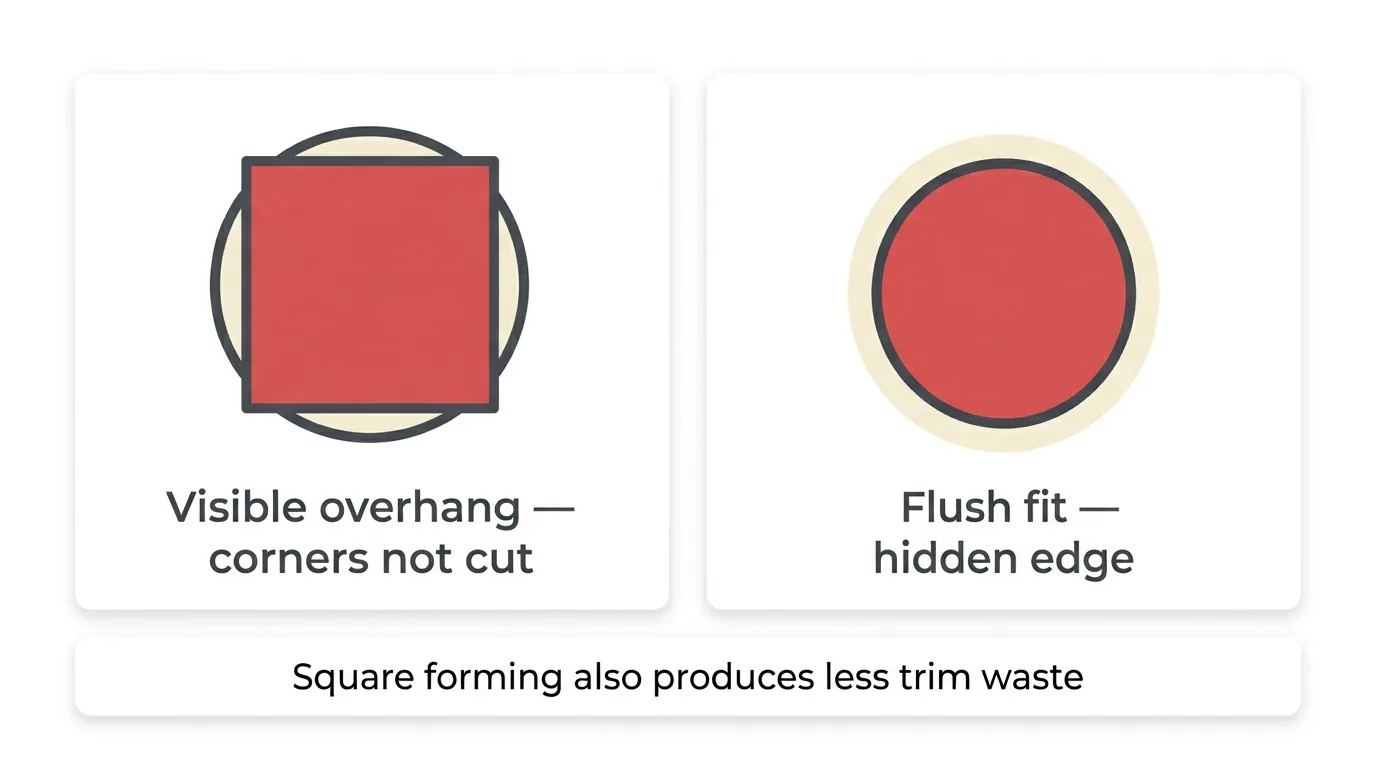
The square patty is the single most recognisable thing about a Wendy’s burger, and the reason is deliberate. Wendy’s frames it as a visibility argument: the patty “hangs over the bun so our customers can see the quality beef before even taking that first bite,” under the founding principle that the company “doesn’t cut corners.”
There is a practical dimension too. A square patty is cut from a sheet of formed beef with effectively no offcut waste, whereas round patties either require re-work of the trim or a different forming process. The shape is both a brand signature and a production efficiency. We cover the history in more detail in our guide to why Wendy’s burgers are square.
The Burger Line-Up: What Goes on Top
The patty is only part of “what it’s made of.” Standard builds across the core burgers use:
- Bun — a toasted premium bun on the larger burgers, a standard bun on the value tier
- American cheese — on cheeseburger variants
- Fresh produce — lettuce, tomato, onion, pickles, prepared in-restaurant
- Condiments — ketchup, mayonnaise, mustard depending on the build
- Applewood smoked bacon — on the bacon variants
Patty counts scale predictably: a Jr. Cheeseburger uses a single junior patty, Dave’s Single one quarter-pound patty, Dave’s Double two, and Dave’s Triple three. Full item-by-item figures are in our Wendy’s nutrition guide, and allergen detail is in the Wendy’s allergens menu breakdown.
Common Misconceptions
- “There’s filler in the beef.” Wendy’s states there are no fillers or additives in the patty. The seasoning is applied on the grill.
- “Fresh means never refrigerated.” It means refrigerated rather than frozen. Chilled transport is the whole mechanism.
- “Fresh beef applies everywhere Wendy’s operates.” It applies to a defined list of markets, not universally.
- “Square patties are just a gimmick.” They are a brand signature and a lower-waste forming method.
- “Fresh automatically means healthier.” Fresh describes the supply chain, not the calorie, fat or sodium content.
How It Compares
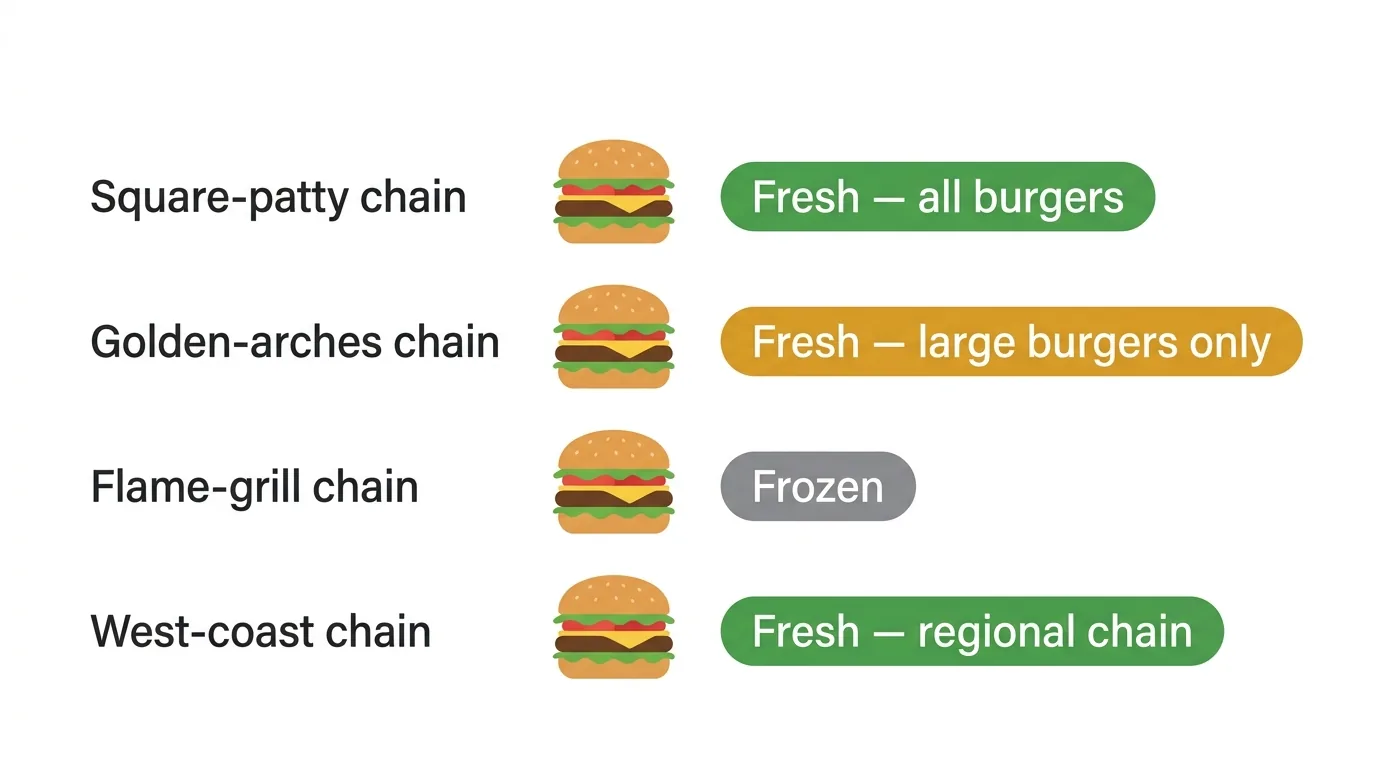
The comparison people usually want is against McDonald’s, which cooks its Quarter Pounder patties from fresh beef in most U.S. restaurants but uses frozen beef for its smaller burgers — so the answer there is “it depends which burger.” Burger King’s Whopper patty is flame-grilled from frozen. In-N-Out, a regional chain, has never frozen its beef. Our side-by-side is in Wendy’s vs McDonald’s compared.
The honest framing: Wendy’s applied fresh beef across its entire U.S. burger line earlier and more completely than its national competitors, which is a real differentiator — but “fresh” is a sourcing standard, not a quality guarantee on its own.
Frequently Asked Questions
What are Wendy’s burgers made of?
100% real beef with no fillers or additives, sourced from Beef Quality Assurance certified farmers and ranchers, delivered chilled rather than frozen, and seasoned with salt and pepper on the grill.
Is Wendy’s beef really never frozen?
In the contiguous U.S., Alaska, Canada, Mexico, Puerto Rico, the UK and select international markets, yes — beef is transported and held refrigerated, with temperature monitored in transit. It is a market-specific standard rather than a global one.
Does Wendy’s use fillers in its beef?
No. Wendy’s states its patties contain no fillers or additives.
Where does Wendy’s get its beef?
From Beef Quality Assurance certified farmers and ranchers, sourced regionally because chilled beef cannot be shipped long distances. Wendy’s does not publish a named supplier list.
Why are Wendy’s burgers square?
So the patty visibly overhangs the bun — a deliberate signal of portion and quality, tied to the founding “we don’t cut corners” principle. Square forming also produces less trim waste.
Is Wendy’s beef grass-fed or organic?
Wendy’s does not market its beef as grass-fed or organic. The published standard is BQA certification, which covers handling and management practices rather than feed type or organic status.
Is Wendy’s beef halal?
Wendy’s does not certify its U.S. restaurants as halal. See our guide on whether Wendy’s is halal for the full picture.
Does Wendy’s add seasoning to the meat?
Salt and pepper are applied on the grill during cooking rather than blended into the raw beef.
How much beef is in a Wendy’s burger?
It varies by build. Dave’s Single uses one quarter-pound patty, Dave’s Double two and Dave’s Triple three, while the junior line uses smaller patties.
Is fresh beef healthier than frozen?
No. Freezing does not meaningfully change the nutritional profile of beef. Fresh sourcing affects texture and supply logistics, not calories, fat or sodium.
